BIOGRAPHY
1991
A "year out" like that is awful for a biographer. You can leave it out and pretend
it had never existed because not much material about it can be found, or you wonder
if it might be THE year in which the ball really began to roll.
In the case of DM I would say it was the latter. For an outsider it is difficult to
understand what exactly was so awful about the subsequent Devotional time. Don't get
me wrong: Of course, Dave's drug abuse was awful, and it was certainly hard to be
with him after this break. But was this really the reason why ALL relationships
were broken off, and why wasn't there "any diplomacy going on" as an inside source
described the situation?
For a long time I couldn't get rid of the impression that there's something that hasn't
been mentioned in any interview or biography so far. Some fans, who took part in
the survey of depechemodebiographie.de, also think the existing sources are not enough.
24% answered the question whether there's actually a "DM mystery" for them, said they
would like to know the exact background details of this period.
But over the course of time, I came to the conclusion that there probably isn't a
big secret behind the whole story, all the information is out there, although the
explanation that the changes in their private lives had been so drastic that they
simply couldn't stand each other afterwards sounds strange on first hearing, especially
because - except for Dave - nothing special happened.
Therefore you could get the idea that there is something missing. But maybe it really
is that simple. Each band member changed in some way, and developed in a different
direction, especially according to their personal interests. This might have changed
the feeling of the group completely.
A lot of people might know this situation: You work on a project very intensively and
then take a longer break. When you come back, you notice that things that have always
been like that suddenly get on your nerves. You just hadn't realised it before, because
you were used to it. But you have changed because of experiences you have had in the
meantime, so you can't stand the old things anymore. You don't like some things that
have changed in the time you were away either, because you feel you should have been
consulted. You find the people are still basically the same, but nevertheless different
somehow. Suddenly you don't like the behaviour you were used to anymore. Sometimes
you find your way back into the team, sometimes you realise you have to quit.
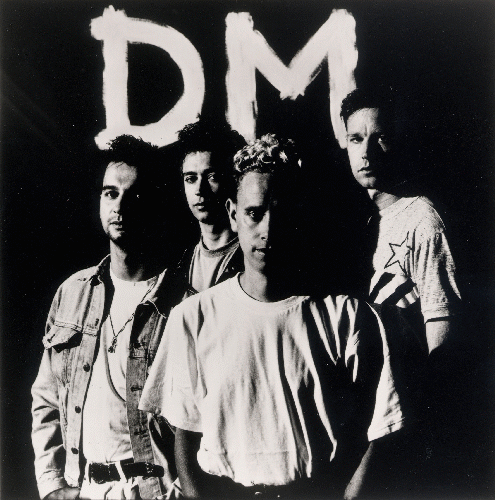
(with friendly permission of © Mute/EMI)
Let's have a look at the changes in the lives of the members of DM.
Dave sought divorce from Jo, and moved to live with Theresa in L.A.
At first he tried to present this as diplomatically as possible:
"It's great! I'm really enjoying it here. I'm
just kind of living here for the moment, and I'm actually still keeping my
place in London, and I'm just ... To tell the truth, I just recently got
divorced from my wife, and I'm just trying to set up a new life. But as I
said, I'm keeping my second home. I'm spending my time between both places.
I'm lucky enough to do that. I just needed to get away and get some space,
and think about what I wanted to do. ... We've worked really hard for the
last 11 years or something. Al's in the studio at the moment with Nitzer
Ebb. He's producing their new album. Mart's living in London now, and just
kind of enjoying himself. I think he's going to be working on another 'Martin
Gore solo thing'. I don't know what Fletch is doing at the moment. I think
he's just kind of hanging out. I think he's thinking of opening a bar or
something. I don't know what it's going to be called, but he's definitely
thinking of that." (He opened a restaurant indeed, but meanwhile gave it up
because it was too much work and took too much time.) "Well, the thing is,
it's fun to be working and doing stuff, and to be in the studio and
creating music, and to be on tour and going out there and playing to
people, but there are times when it's incredibly lonely. I mean, I'm not
moaning about it. I love it. I wouldn't do anything else. It's the most
exciting thing you could possibly be doing. I wouldn't change it for the
world, but there are times when you lose contact with your friends, and it
can be incredibly lonely and you go, yeah, I want to have some fun."[1]
He actually wasn't well this year at all. He suffered from the divorce
of Jo and having left his son. He admitted this within later years:
"In the space of six months everything just piled on top of me.[2] I just
packed a case and split. Went off and rented a place in Los Angeles.
During the Violator-tour, I split from my wife. My year was really spent
doing a lot of soul-searching and trying to find out what had gone wrong
in my life, and thinking, to be quite honest, about whether I wanted
to come back and do the whole thing - records, tours, fame, Depeche
Mode - again."[3]
His band mates had a different view on this whole thing. So Alan would say
that it was easy to influence Dave, and Fletch had a similar
opinion: "Dave tends to adopt the personality of the person he's with.
Theresa liked drug-ravaged skinny men with tattoos, so he became
that person."
And maybe there's some truth in it.
Dave: "For as long as I can remember, I've had this shield between
me and life. As a teenager it was music. Then it was Depeche - that was my
identity. Then that identity stopped working and the drugs and booze
really kicked in as a new identity. I became so lost I was really unsure
whether I could find my way out."[4]
So Dave really changed. He must have been an almost completely different person
when his band mates met him again in February 1992.
Although Fletch used to say that he had been the one who kept the band together -
why not think about what kind of role Dave had in the team? Could it be that
he was the one who brought in some kind of balance to the team, especially to
the team-spirit? Think about the "conservative and adventurous sides" of the
band. If Fletch was a kind of spokesman for Martin, maybe Dave was the one
who brought the two sides together?
When I had the opportunity to talk to Steve Lyon, I asked him about
Dave's role within the team, and also about the balance he might have brought in.
"Well, a band is a balance. And when the balance becomes difficult ...
unfortunately, the band fell apart ... but, yeah, Dave and Alan were the more
adventurous in the material. I can remember sitting in Spain and chatting with
Dave about the Red Hot Chili Peppers in which Alan also was very much into,
the stuff coming from Seattle, American rock bands, hearing Nirvana on MTV
the first time, Perry Farrell's band Jane's Addiction. Their album came out when
we were recording SOFAD. Dave was a big fan and I sat down and listened to
together with Dave, and that was something Martin and Fletch never listened to.
Flood also was influenced by many things. It was a pretty impressive team I
have to say. My job was to make the sounds more adventurous and creating a
platform for Alan and Flood to work on. I think it was a very creative time.
Fletch can be a very negative person about what can happen next, and I think
he was worried a bit about the change from Violator to SOFAD.
Alan, Flood and myself were not and nor was Dave. I think Martin was kind of
middle ground ... but we all knew there's was something good in what we were
doing. Later they were very much surprised by the success of SOFAD considering
what had been spoken about during the making of the album. Like 'Is it too far
away from Violator?' But if you ask any Depeche fan about his favourite
albums, he will probably say Violator and SOFAD. When I started
working with them I was completely unaware of the back catalogue. I knew some
old singles and old songs, but I really didn't know them at all. And I remember
we took a break at the recording in London and I got a delivery from Mute with
the whole back catalogue of Depeche stuff and I sat down at the weekend and I
was completely blown away. I was like, 'Wow, why I never knew this?' And I remember
I was talking to Alan and Flood about it, and for them this was a good thing.
On a creative side this is a good thing because you are not afraid to propose
ideas or change sounds and do things. When you are aware of the band's history
and their success you can get scared and on a creative side that can be bad.
You can always get backwards. The step forward is the most difficult thing."[5]
Remember Alan saying that Dave wanted the band to "rock out more" - long before
SOFAD. For Dave it had also always been very important to move on, to take
a step forward, to develop further. So he might really have been the one who
supported Alan when it came to discussions within the band about making experiments.
But although Dave was very enthusiastic about SOFAD, and tried to contribute
as much as possible, he was ill, and thus not able to fulfil his role in the team
completely.

It took a while before Martin started to write new songs. He had obviously
overdone the partying on Worldviolation a bit, so he was burnt out. For a while
he was thinking about doing a solo album, but then something new stepped into his
life, that gave him back his creativity - his first child.
"The new album [SOFAD] has a very uplifting feel to it and I'm
sure that is due to my daughter. You see a life being born and growing,
it's just wonderful, it moves you."[6]
Viva-Lee was born on 6 June. Before that, his mother had told Martin the
whole truth about his real father.
Fletch: "Actually, his dad is American, and he's black and lives
in Virginia. Since then, Martin's met his dad."[7]
It seems that this was quite a shock for Martin, and that the first meeting with
his father didn't go very well. Maybe these things made him more sensitive to the
"emotional violence" of the situation in 1992, until it finally all
became unbearable for him.
Also Fletch and long-term girlfriend Grainne became parents, when they had a
daughter, Megan.
Fletch was suffering from depression during the recording sessions in 1992,
so he couldn't fulfil his role in the team either.
Maybe the team collapsed because Dave and Fletch were ill, and couldn't liaise
as usual between the two musical leaders.
For Alan, things settled down a bit this year too. He married his long-term
girlfriend Jeri, although he would say about her later that she was
"someone who thought she was descended from the lost city of Atlantis
and of alien origin."
Nevertheless, they bought a house in the Sussex countryside, and a house for
his own studio. "I've invested a lot
[of the money I made] back into my music via my studio and all its equipment
and also into my house and estate. I also bought my parents a house."
The studio, The Thin Line, is in a house built in the mid. 19th century,
adjacent to the bigger residential house. It was intended to become
"a living, breathing space designed not
necessarily for controlled sound but with the feel of a workshop, with
plenty of light."
During 1991 a team of expert builders, electricians and steel workers
spent 6 months gutting, reinforcing and re-wiring the building.
"It was always my
intention to design this studio so you could simply remove all the gear and
be left with a really interesting open-plan building."
At that time he also was busy with a lot of other projects.
He was co-producer of Nitzer Ebb (album Ebbhead), together with Flood
(before he left to produce U2) and Steve Lyon, and he recorded the first bigger
Recoil project, Bloodline, again together with Steve Lyon - but not in
his new studio, because it wasn't ready yet.
"It was recorded at my house in London. My studio there was just a small back room
with too little space and too much equipment."[8]
Some people think he bought his studio AFTER his decision to leave the band. But
as you can see, he had bought it long before that, and he was obviously interested
in exploring new directions. He didn't use this break to hang around and have fun,
he kept on working. He actually ran out of time. He probably wasn't thinking about
leaving the band at that point, but it is possible that the process that finally
led to his decision had already started at the end of the Worldviolation (or maybe
even earlier, when he started Recoil in 1986.)
Alan in 1992: "What happened was, last year Depeche Mode decided to take a year
off, and I didn't want to just stop and do nothing for a year, so the obvious thing
for me to do was to just do some work on my own. To me, it's as important as working
with Depeche Mode even though Depeche Mode is still my main thing. But to me it's
just important to make music and be creative. I can't stand just sitting around
watching the clock tick by. I always feel guilty I should be doing something."[9]
I think the last sentence is the most important one. It shows how eager he was to
work, to be creative, and to make music. Seeing himself confronted with a changed
team a little later, which slowed down the whole process, must have been frustrating
for him.
In this year there the only contact between band members was between Alan and
Martin, who met in spring 1991 to record Death's Door together,
engineered by Steve Lyon, a single song that was released on 10 December,
as part of the soundtrack for Until the End of the World.
(Martin sang the lead vocals on this track.)
Martin: "We literally did nothing for a whole year apart from the song for
the Wim Wender's film, which only took us about 2 days to do, so we really had about
363 days off." (laughs) "I think that [Death's Door] was actually the first
showing of a gospel direction, I think it had a real sort of gospel feel to it
that pointed the way to this album [SOFAD]."[10]
Also in December, Dave decided to carry on with DM, because Martin's
demo-tracks to SOFAD seemed to suit his current lifestyle perfectly.
References:
[1] KROQ radio, L.A., 9 May 1991, Interviewer: Richard Blade
[2] In the Mode, Details, April 1993. Words: William Shaw
[3] "I Never Wanted to Destroy Depeche Mode", Melody Maker, 3 April 1993. Words: Jennifer Nine
[4] Songs of Innocence and Experience, Mojo, November 2005. Words: Danny Eccleston
[5] depechemodebiographie.de
[6] The Life and Loves of Depeche Mode, I-D, October 1993. Words: Michael Fuchs-Gambock
[7] Blank Celebration, Revolver, May-June 2001. Words: J. D. Considine
[8] recoil.co.uk
[9] Depeche Mode Spinoff Band Releases First U.S. Album, Chicago Tribune, 28 May 1992. Words: Jim Sullivan.
[10] Dave & Martin interview, KROQ, March 1993. Interviewer: Richard Blade and Jed the Fish.