BIOGRAPHY
1992
Apart from a questionnaire in Bong magazine published in April 1992,
there was nothing in the media about the band that year.
Question: "You always seem so easy-going, but do you ever get in a temper and
start shouting? If so, what is usually the cause?"
Alan: "Sometimes, for various reasons."
Question: "If one of the other band members showed up drunk for a show,
what would you do?"
Alan: "Nothing. Each band member is aware of his responsibilities."
Question: "Do your parents listen to your music and if so, what do they
think of it?"
Alan: "Yes they do, but I don't think they like it much."
Question: "What or whom do you miss most when you're on the road?"
Alan: "My independence, family, QPR (Queen's Park Rangers) home games,
cooking for myself and driving."
Question: "Which do you prefer, working in the studio or playing live?"
Alan: "Working in the studio."
Question: "Do you see yourself being in Depeche Mode for the next ten years?"
Alan: "No."
Question: "What are your feelings now that you're faced with recording
and touring again?"
Alan: "Apprehension."[1]
But when were these questions answered? In April? Or before the band's first meeting
in February? Unfortunately it's impossible to tell from the Bong article.
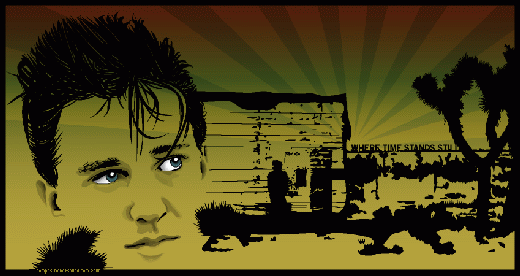
(with friendly permission of © Anja - compositionofsound)
The rest of the story appeared in later years and was anything but pleasant.
The first meeting of the band in a villa near Madrid to record
Songs of Faith and Devotion (SOFAD) was a disaster. During two sessions -
each about six weeks long - with a break of a month in between, the band lived
there together.
(By the way - this was nothing special. At that time (at the beginning of the
1990s), it was "hip" to rent a house, live there like a kind of family and produce
an album.)
Dave: "In theory, it was a really good idea, but we found that our
personalities clashed incredibly when living together 24 hours a day,
seven days a week. I didn't mind it so much, but Alan detested it and Fletch
had a hard time.[2] However, I'd changed, but I didn't really understand it
until I came face to face with Al and Mart and Fletch. The looks on their
faces battered me."[3]
Alan (trying to be diplomatic): "The fact that we took a break away
from each other, that people went and did things with their own personal
lives - had children and moved to different parts of the world - has given
us all a different perspective on what the group was and is, and what it
means to us all. Coming back together has taken a long time to get used to.
I think, for a long period this year, there were a lot of disparities
between the different members of the group."[4]
Fletch: "Dave would come forward on a real burst of energy, do a
vocal, then disappear to his room for a couple of days. It was a bit odd."[5]
Dave: "A lot of the time it was hard for them to even want to be in
the same room as me."[6]
Martin: "It was an absolute disaster. We all hated it there, because
it wasn't really in the centre of Madrid. It was about 30-40 minutes outside.
So every time we wanted to go out, we had to get cabs into town. Also living
on top of each other became difficult. We never had space from each other."[7]

Some of their statements seem to be a bit contradictory at first glance. On the
one hand, Alan felt disturbed by lots of acting up, as he said once, on the other
hand, it is said that Dave was in his room most of the time and Martin was out
partying. What did he mean exactly? The only one who obviously was often in the
studio was Fletch because he felt his privacy was disturbed. The same here: if
Dave wasn't around and Martin wasn't around - how could he have felt his privacy
was disturbed?
Martin's remark about never having space from each other seems strange too. I saw
pictures of the villa: It's very big. Of course, they weren't alone, there were
also members of the crew there, but it's nevertheless a bit strange because the
band members were just referring to the presence of the other band members, not
to crew members. Now one could think that Fletch was disturbing Alan when he was
spending most of the time in the studio, but his depressions were known to Alan
meanwhile. It is said that Fletch wasn't well. Sometimes he was hyperactive when
he had taken anti-depressive tablets. Sometimes he didn't say a word, and just
sat silently in a corner of the room.
However, the main point was probably that Alan was eager to work while no one else
in the band seemed to show much interest.
Dave: "Alan was angry that he spent 12 hours in the studio while
Mart was getting drunk somewhere and I was doing something different.
He was the one who was trying to keep things together while everyone else
was busy with their ego-sh***. But nobody thanked him."[8]
Alan: "It's fair to say that the majority of the
production/sound-shaping side of things on the last few albums was down to me and
Flood with Martin bringing in a few keyboard and guitar lines from his
original demos.[9] A lot of the time it's myself and Flood who are left there
in the early hours of the morning, doing what we call 'screwdriver' work. It's
sifting through bits of performance and restructuring it, which bores Martin
most of the time and Dave to an extent.[10] In fact, it's been suggested that
I was unsociable, spending too much time in the studio. The truth is that the
job just wouldn't have gotten done otherwise. It disappoints me that anybody
would think that wanting to achieve the best possible results isn't worthwhile."[11]
And why exactly Martin didn't feel well? He knew the depressions of his friend,
he knew how fixated Alan was on studio work. So what exactly was different or worse
in comparison to Violator? Why did something not work anymore that had worked before?
Martin: "I felt totally distanced from the rest of the band, I really
didn't want to be there. Up until that point we always felt like a gang -
then suddenly it felt really wrong for the first time.[10] I think when we
first got together in Madrid it became obvious that there wasn't a real
feeling of band unity."[12]
So, obviously the changes of the individual team members in their personal development
led to a loss of team-spirit. And as it has been mentioned before - you'll find people
basically the same but nevertheless you can have a different view on them when you've
stepped back for a while. Living so close together they probably found out some things
about each other they didn't want to know ...
The band members also had very different ideas of how the album should sound,
so the studio work took a lot of time. It needed some jam sessions to find a basic
sound for it.
Alan: "With all DM albums, we tried to move away from the previous one
and after some discussion between myself, Flood and the others, we agreed that
our approach should be more towards performance and to try to push ourselves
into areas we hadn't explored. Some of the songs like I Feel You,
In Your Room and Rush suggested a looser, more 'live' feel."
But it was a difficult process, before they were able to get in a creative
working flow.
"Everybody tries to pull a record in their preferred direction. Sometimes
those tensions help but normally they slow down the process while the person
who has a problem argues their case, after which either a compromise is
reached or they lose the debate and go off and sulk for a bit. Personally I
find continually having to put your ideas to a committee wears you down after
a while and ultimately stiffles the creative flow."[13]
This is what Alan said later, after leaving the band. It shows the main point
of his frustration with the team-work at the time. From a certain point, he didn't
like making compromises anymore.
In 1993 he explained:
"Martin gets bored very quickly in the studio, Dave gets very enthusiastic,
but he's not a musician as such, so he can only contribute to a degree, and
Fletch doesn't have a musical role at all. Martin always errs on the melodic
side, he's a pop merchant, so he pulls in one direction a bit, and I always
try to pull it in a darker direction 'cause that's the music I tend to
listen to. We meet in the middle and end up with pop music that's got an
edge to it, so it's more interesting, it's got more depth plus it's all
melodic."[14]
This is the best description of what made DM's music special "in the old days",
and that is what the "old fans of the DM with Alan" mean when they're trying to
explain why Alan was such an important part of the band for them. The point is
not that Alan is such a great musician or producer, but that he was a counterpart
to Martin.
"Their musical tastes were quite different," Steve Lyon said about Alan
and Martin. "And I think that this blend of what they were doing made it work to
be honest. I remember being in the studio in Spain and I went to see Martin in
his room and he was listening to soul music, gospel, Elvis, 80's electronic music,
he had a very wide taste. And the same was with Alan. When you listen to Recoil
stuff ... the track we did with Moby, [Curse], when you listen to Moby's
solo records they are almost identical to what he did with Alan. I don't think
they had really a different musical approach. It wasn't too much of a problem."[15]
Maybe not the different musical approaches as such, but obviously the compromises,
and especially the communication about it. It seems that Alan enjoyed the work with
the production team very much, but not the work with the band. This might be an
explanation for his contradictory statements about having fun and finding it
unbearable at the same time.
This time it really was difficult to "meet in the middle" and so they finally
did something that for them was quite unusual:
Alan: "I can remember the first time we recorded Walking in My Shoes.
It was the first, and possibly only, time the band has ever jammed together.
We were never that kind of group; we just meticulously programmed music. Yes,
there would be performance elements, but they tended to be overdubs and
single-person performances. We were getting nowhere; we had tried different
ways of recording that track, and none of it sounded any good. So after the
third or fourth time, Flood finally said, 'Look, just all sit down,
pick up an instrument and play something together.' And that was met with
derision. 'What? What are you talking about? Play together?' Alien concept to
Depeche Mode. So Martin had a guitar, I had a bass, someone else had a
tambourine, we had a little rhythm box going, and we just made this noise.
And after that, we got the main groove for that song, the bass line and
guitar lines. I'm not saying it was anything special. All I'm saying is that
the process was so different and so unusual, and we did get a result
from it. I wish we had done more of that kind of thing."[16]
Alan's main problem was obviously with Martin, because about Dave he said,
"With this record we've
tried to make Dave sing in a different way. In simple things, like raising the
register of the song so he has to sing higher than he would normally, forcing
him to approach songs differently and making him go over and over things, trying
different environments in which he hasn't sung before, not using headphones
like we normally do, anything to try and get a different performance. He's
responded really well. Dave has a very good attitude. He's willing to try
things even if he doesn't understand why he's being asked to at the time."[17]
On the other hand, when he was longing for some rest after studio work,
Alan had to bear Dave's exercises on E-guitar next door.
"Although Dave was filled with enthusiasm by the
idea of a new album actually, he committed himself no longer
strikingly soon. But he came down into the studio now and
then and praised Flood's and my work as the only one.
He was at least worried about the group, in which constitution
he himself identically was."[18]
This constitution got worse in the course of time.
Dave: "Alan was the first who confronted me with that."
Martin: "Then we had our first ultimatum-meeting with Dave. We
said to him, You've got to sort yourself out. You're putting yourself in
danger."
Dave: "They were genuinely concerned about my health. Of course, I
couldn't see that. I said to Mart, F*** off! You drink fifteen pints of
beer a night and take your clothes off and cause a scene. How can you be
so f*** hypocritical?"[19]
(It was a serious situation but I can't help laughing, though, every time when
I read, "You drink fifteen pints of beer a night and take your clothes off and
cause a scene." It's probably the best description of what you got when you went
out with Martin in the 1980s.)
Martin: "Dave was taking a lot of heroin at the time, which took
me a while to realise. I'm not a drug expert, I don't know all the
symptoms."[20]
At the meeting Alan had organised in London, Martin finally realised that Dave
was taking a lot of heroin at the time. "To be honest I was really ignorant,
but once the pieces of the puzzle had been put together for me then it all
made sense."[21]
(Edge to Life - with friendly permission of © Milla Valta)
In the meantime - almost overseen - on 9 March, the single Faith Healer
was released, followed by the Recoil-album Bloodline which was released
on 13 April. Bloodline was markedly different from Hydrology,
particularly since Alan had gone in a new direction musically. So he worked with
some vocalists like Moby, Toni Halliday and Douglas McCarthy. He worked out a
piano improvisation (Freeze) and an homage to Kraftwerk with the song
The Defector, and he gave a new tune to recordings of Bukka White.
Alan: "The original Bukka recording is virtually acapella - he is actually singing
to an acoustic guitar but the guitar is just about inaudible. It therefore
seemed to be a very interesting source of material to try and do something
unusual with. I also loved the sound of his voice - particularly when he
talks in his own unique language / babble. Certain lines were sampled,
re-structured and then filtered. [...]
I didn't feel any pressure to make an
album which was more conventional but I couldn't produce ongoing experimental
instrumental music either.[22] However, I didn't really see it through in
the way I should have done; I think I lacked the energy. I had Depeche Mode
commitments, and I was really fitting Bloodline into the first real break
the band had taken in 10 years. By the end of that year - while also
producing a Nitzer Ebb album - I'd just run out of energy. I think the album
suffers a little bit because of it, especially the vocals."[23]
For a while, it was planned to release Edge to Life as another single, but
"by that time, I had already moved off into another DM project
so I didn't have the time to promote it."[24]
While I never got any answer according to the question if I might stream excerpts
of Depeche-Mode-songs on this website, Alan kindly granted me to do so with
Recoil-songs.
So here is an excerpt of Curse:
(with friendly permission of © Recoil / Alan Wilder)
In April Dave got married to Theresa. No other band member attended
the ceremony. He had a lot of tattoos done, motivated by Theresa.
Within the later years some biographers and journalists tried to represent the
relationship as if Dave would have influenced Theresa more than the other way
around, because she was willing to fulfil his desires for drugs and sex. Dave
isn't a "milk-and-honey-type" (as Alan once remarked) at all, but reading between
the lines you come to another conclusion about who had influenced whom.
Dave: "I mean, my wife's American, and you know, she's really
aggressive, and I've definitely picked up on that. And most of the time
she's dead right about what she thinks. She's said things to me over the
last year that've completely changed my view about a lot of things I was
doing, and she's done nothing but encourage me. So I came back fully
loaded with plenty of passionate ideas, and everybody else was kind
of like, 'Well, actually, we've just been at home with the wife and kids
for the last year, so calm down a bit there, Dave.' Now I realise it, but,
at the time, I just felt like it was me and them. I'd just shut myself up
in my room in Madrid and start painting. I hadn't put brush to canvas for
10 years. I spent four weeks in the studio all day, after which I couldn't
sleep, so I'd be up all night painting [for Theresa]. I remember when I'd finished,
Martin said to me 'Oh yeah, you know, I didn't realise you could paint.'
And I said, well, yeah, that's what I used to do, Mart, that's all I could do.
I was in art college for three years, and the only thing I was even any good
at was painting. [...] I have more rocky and bluesy influences than the others
in the band. So when Martin started sending me bluesy demos for the new
record, I thought, great! And the lyrics were completely appropriate to
the way I was feeling. It was almost like Mart was writing the stuff for me.
I think Condemnation is by far my finest vocal performance. When I
came into the control room everybody went all quiet and turned around,
and suddenly Flood said, 'That was f*** great!' And Alan and everybody said,
'That's probably the best vocal you ever did' - and I thought, yeah, it was.
It was completely breaking me up inside, and, at the same time, it was really
optimistic and uplifting. [...] I definitely won my battles, to be quite honest -
cos when we began this record, I knew it would be good for us to get a drummer.
So I kept pushing and pushing and, in the end, Alan got on the drumkit and
said, 'Well, I'll f*** do it, then!'"[25]
Alan had a different memory to this: "I'd been considering it for a while
and eventually mentioned it to Dave who thought it was a good idea."
(By the way - I was asked by a reader if Alan learned to play the drums for SOFAD.
He had learned it before (he played the drums on Clean for example) but did
special exercises for SOFAD and the Devotional tour.)
About Dave's vocal performance Alan said, "I worked personally with Dave
for many years to get the optimum performance out of him and I actually believe
that some of his best vocals are on the SOFAD album. Dave's voice on
tracks such as In Your Room, Condemnation, I Feel You and
Walking in My Shoes absolutely mirrors the intensity of the music.
Obviously there is a degradation in his vocals during some of the live
performances from Devotional but this is purely down to the stresses
and strains of extensive touring and perfectly understandable. That said,
I would rather hear a cracked and 'rough' sounding voice that is full of
emotion, to one that is technically perfect but bland and lifeless."[26]
Later Dave explained that he had planned the transformation of simple
Dave from Basildon to a monster: "Well, I did. During the Violator-tour.
Not overnight. There were a couple of ingredients missing: a companion in
doing everything it took to be a rock'n'roll star - which turned out to be
Teresa, my second wife - and ... the drug. I wanted to lead that very
selfish lifestyle without being judged. She was joining in. In fact,
she introduced me ... she didn't make me take heroin, she gave me the
opportunity to try it again. I'd actually played around with it back in
Basildon, didn't inject it at that time, however."[27]
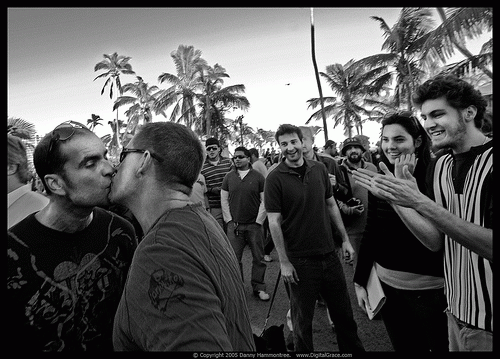
(Thou Shalt Love Thy Neighbour
As the homosexual CONDEMNATIONs flowed from the mouths of the born again
street preachers, many same sex couples walking by would stop and make-out
with each other in front of the soapbox sermon. While the couples made-out
the street preachers would scream out specific chapters and versus backing
their case for why these acts were an abomination unto God. The crowds that
had gathered were mostly amused by the absurdity of the preaching and loudly
cheered on the gay and lesbian couples that would stop and kiss.
- with friendly permission of ©
Danny Hammontree)
In the meantime, the relationship between Fletch and Alan collapsed.
Martin: "Alan really didn't get on with Andy. We've always been
honest about the fact that Andy's not really musical. And Alan around that
time was heavily involved with what made Depeche Mode, in production and
arrangement. I think he felt that it was wrong that he was making the
same money as Andy, who basically doesn't do anything in the studio."[28]
An inside source told me that money had definitely been an issue, but I don't
think that money was the main point. From the production of Violator onwards,
the band started to fall apart. Fletch's depressions and Dave's drug abuse were
both increasing and having an impact on the team-spirit. Martin took a backseat,
while Alan was heavily involved in the studio work. It seems that he had the
increasing impression of being the only one who was working, and that he felt
forced to take over the tasks of the other members of the team. In a situation
like this one can get the idea of being overworked and underpaid. But it was
probably mainly about being disappointed that no one seemed to notice how much
work had to be done, and how much work he was providing.
Alan says about himself that he is sometimes quite cynical. It is said that
there were a lot of arguments going on between the band members during the
recordings of SOFAD and during Devotional. It's not known what
these arguments were about, but it's easy to guess when reading between the lines.
Alan said he was accused of being unsocial, and one of his answers to this might
have been: "At least I'm doing something in contrast to this lazy sod that never
does a single thing in the studio. I wonder what he's paid for." With this you
are right in the middle of a money-discussion although the main point is something
completely different.
While some fans share Martin's opinion - "Andy, I think, finds it most
annoying when he goes into interviews and has to basically just talk for the
whole interview about the business side of the band. Everybody thinks that he's
totally incompetent as a musician, and think that even when he's onstage playing
with us that he doesn't play a note 'cause he's not capable"[29]
(although Martin often said something completely different, see the quotation
above, but note that it dates from 2001 while this one dates from 1993,
and might be a result of arguments of this kind) - Alan, Fletch himself and some
other fans think that Fletch's role really is a different one. (He even said once
that he was in the band by accident, and wasn't interested in making music that
much.) But, of course, it will hurt you badly, especially in Fletch's state of
mind at that time, when there's someone who gives you the feeling of being useless,
lazy and overpaid. In Alan's view (he said it between the lines or even directly)
Fletch never had any musical role. It's obvious that Alan didn't take Fletch
seriously at all (understandable from his point of view) and probably Fletch
couldn't deal with that (which would be also understandable).
However, I think Fletch's role in Alan's decision to leave the band and the fact
that Fletch earned the same money as Alan are overrated. There are still many
fans who believe Alan left the band because of Fletch. Some even believe Fletch
mobbed him out. But I don't think Alan is someone you can mob out that easily.
He probably never really got on with Fletch, but hadn't been bothered by it for
more than ten years.
Of course, that these two characters couldn't get on with each other anymore in
this tense recording situation didn't make things easier, especially when you
remember that Fletch was a kind of spokesman for Martin. So the problem might
now have been that there wasn't much communication going on between Martin and
Alan anymore.
The relationship between Alan and Dave - maybe not real friends, but good mates
at least - suffered from an event, too, when Dave provoked a group of Hell's
Angels in a bar in Madrid.
Alan: "I think Dave's words to one of them were: 'What are you looking at,
you fat c***?' About 10 minutes later, all hell broke loose with several
resulting 'autographs' in the form of bruises and black eyes - none received
by the bikers though. Miraculously, none were received by me either. I have
an uncanny knack of making myself invisible during times of extreme
violence. It was disappointing for me [when I found out that Dave was taking heroin].
Not for
any moral reasons but because his drug use adversely affected his personality
and more specifically his greatest asset, his sense of humour. There was also
an increase in general apathy. It didn't necessarily
turn him into a monster or anything but, obviously, Dave was in his own world.
Consequently this made normal communication more difficult, which was an
added pressure in an already quite tense group relationship. It was just a
bit sad from my point of view because he wasn't really 'there' a lot of the
time and I missed his sharp wit." (Maybe Dave's previous role in the team had
been solving problems and diffusing tension with his humour.)
"Nobody else in DM has ever taken heroin as
far as I know so I imagine Dave felt alien to the rest of us at this time.
A distance arose between Dave and me which made me sad,
particularly because he is actually an enthusiastic and
vigorous person. Dave is also very generous and frank but
perhaps this is the problem, and yes, of course, everybody
tried to help him but I don't think that someone of us
really understood what the matter was actually. It isn't
easy to help someone who's on a mission."[30]
I'm not quite sure whether Dave was referring to the same story about
that bar in Madrid, when he told many years later that he had been suffering from
withdrawal symptoms once during their stay in Madrid. "Everyone scrabbled
around to find what they thought I needed - booze, coke, hash, pills. But heroin
wasn't provided. I went looking in some subterranean club. I approached some guys
who looked like they might be in that vein, but I got a severe beating outside
instead. I remember rolling under this car, snow on the ground, and Martin trying
to intervene and promptly getting punched."[31]
From the context the impression was given that it was an incident which caused
a distance to Martin. It seems as if Martin lost his faith in him because Dave
said it had taken him a long time to earn his trust back.
The band had a break and then met in Hamburg again, where they worked from
10 to 29 August in the Chateau du Pape Studios (today Home Studios).
Things ran a little more smoothly there.
(By the way: did you know that the German Heavy-Metal band Helloween and DM
were recording at the Chateau du Pape Studios at the same time? Helloween's
Michael Weikath said that, "there were girls everywhere but they
weren't there because of us. We had to fight our way into the studio through
lots of 15-year-old girls. Depeche Mode were nice, we often talked to them.[32])
Alan: "Fletch went back to England and booked himself back into The
Priory" (because of his depressions) "Dave only really showed up to do his vocals,
and that left myself,
Flood and Martin to get on and knock the album into shape."[33]
But according to rumours Martin also went on pub crawls lasting days at that point,
and Dave sometimes disappeared for days on end. His drug addiction was so obvious
by then that there are rumours about some quarrels about it.
Other sources say that the band almost never left the studio (it's, of course,
a question of how well these persons know them and to whom they were referring
when saying that they never left the studio) and that things between Alan and
Martin went well in this period, and that they often had some "hotel bar gigs"
with Alan playing the piano and Martin singing. The latter was, however, nothing special.
Alan: "We had hundreds of imprompu sessions around bar-room pianos
the world over. It was quite a common thing for myself and Martin to take
over the piano in hotel bars. My sight reading is poor (mainly through lack
of practice) but it's never been a problem for me to play by ear or from memory.
I've always been able to improvise quite easily and
Martin seems to know the words to every song ever written."[34]
Things like these seem to be contradictory to the "very bad relationship" between
these two characters. In one statement Alan differentiates between the "human side
on which we got on well" and the "working / musical side", but there's also a later
statement (around SubHuman) when Alan said that Martin might never have
liked him. According to doubtful sources Martin said that Alan was more communicative
in Hamburg so it had been easier for him to get on with him, while Alan said
that the "smaller producing team" made things easier.
Maybe these things are so contradictory because journalists and biographers quoted
or translated them wrongly. Maybe it is just a complex thing - Alan and Martin have
some things in common and might get on well here, but they differ on some points
and might get on badly there.
It really seems that it was a constant up and down, and not a permanent tension,
because there are also statements from this time saying that it wasn't that bad.
It also really seems to be a problem within the band itself, not so much a problem
within the whole crew that was working on SOFAD.
So Steve Lyon said, "Well, certainly towards the end of the time I was
working with them or during
the time in Spain and then a little bit in Germany it was quite obvious that
Dave was having a bad time. He had a lot of support from everyone, from the band,
certainly from me, certainly from Flood, from Daniel Miller. Everyone could
realise that he was having a difficult time. But it didn't really stop the creative
work. When I look back at this time, Violator, Violation-Tour, pre-production
of SOFAD ... I wouldn't say it was a dark, difficult period. Completely
opposite, I had a great time. They are really nice guys, they are brilliant to
hang out with. I can remember walking around the Reeperbahn in Germany, with the
band and the whole crew, having a great time! We weren't worried about fans or
anything, just having a good time. Going back to the hotel, where we stayed there
in Hamburg, sitting around the piano, playing, singing, fans coming in, watching ...
it was a very happy, creative period. Unfortunately Dave had a difficult time but
it hadn't an influence on what we were doing."[35]
The last recording session took place in the Olympic Studios in London. They worked
together with a gospel-trio - Hildia Campbell, Bazil Meade and Samantha Smith -
a pipes-player, Steafan Hannigan, and a string-orchestra.
Martin: "We got the choir in and I was just sitting at the back thinking
'this isn't going to work, I don't know why we're trying this', I was really
nervous about the whole thing. But the moment they started singing, for me,
it lifted the track onto another level, it was just up there somewhere, and
so then I decided I shouldn't be so closed-minded about the whole thing."[36]
Alan: "Once we decided we wanted 'real' strings, there was only
really one or two choices as to who should arrange them. Will Malone arranged
the strings for Massive Attack's Unfinished Sympathy, a particular favourite
of both myself and Martin. The strings were recorded at Olympic Studios in
London, using a 28 piece sting section, to which Martin sang the vocal 'live'
- thus equalling the fastest ever recording of any one DM track, the other
being Somebody."
While they agreed about One Caress, they didn't about Judas.
Alan: "Martin and I didn't really see eye to eye on Judas.
We actually recorded that track in 3 or 4 different ways. The final version
was completed very late in the day and Martin didn't say much about it which
is his way of indicating he doesn't like something.
I think Martin was quite attached to his demo version but I felt it needed
more atmosphere. He in turn didn't like the sequencer end-section. It was
omitted for the live version because it wasn't really suitable in that
particular context."[37]
At the end of December, the album finally got ready - with a big delay.
References:
[1] Ask Alan, Bong 16, April 1992
[2] Mode Three, Future Music, April 1997. Words: Uncredited
[3] They Just Couldn't get Enough, Q, March 1997. Words: Phil Sutcliffe
[4] Devout Moded, Vox, February 1993. Words: Martin Townsend
[5] They Just Couldn't get Enough, Q, March 1997. Words: Phil Sutcliffe
[6] In the Mode, Details, April 1993. Words: William Shaw
[7] Mode Three, Future Music, April 1997. Words: Uncredited
[8] Source can't be found anymore
[9] Alan Wilder Interview, Future Music, Issue 62, November 1997. Words: Andy Jones.
[9] Biography, International Music Publications, 1993, author unknown
[11] Alan Wilder Interview, Future Music, Issue 62, November 1997. Words: Andy Jones.
[12] Just Can't Get Enough, Uncut, May 2001. Words: Stephen Dalton
[13] Many Smack-Free Returns! Q, June 2001. Words: Dorian Lynskey
[14] www.recoil.co.uk
[15] depechemodebiographie.de
[16] The Highs and Lows and Rise of Depeche Mode, FHM, June 1993. Words: Andy Darling
[17] Bullz-Eye, 10 May 2010, Word: David Medsker
[18] Biography, International Music Publications, 1993, author unknown
[19] www.recoil.co.uk
[20] They Just Couldn't get Enough, Q, March 1997. Words: Phil Sutcliffe
[21] Just Can't Get Enough, Uncut, May 2001. Words: Stephen Dalton
[22] Many Smack-Free Returns! Q, June 2001. Words: Dorian Lynskey
[23] www.recoil.co.uk
[24] Unsound Recordings, Sound On Sound, January 1998. Words: Bill Bruce
[25] www.recoil.co.uk
[26] "I Never Wanted to Destroy Depeche Mode", Melody Maker, 3 April 1993. Words: Jennifer Nine
[27] www.recoil.co.uk
[28] Tears of my Tracks, Q, March 1997. Words: Phil Sutcliffe
[29] Just Can't Get Enough, Uncut, May 2001. Words: Stephen Dalton
[30] Plugged In, Creative Loafing, 2 October 1993, words: Katherine Yeske
[31] Interview with Dave Gahan, Mojo, 22 March 2013. Words: Martin Aston.
[32] www.recoil.co.uk
[33] Helloween in Hamburg, Metal Hammer, Issue 3 2010. Words: Marc Halupczok
[34] Just Can't Get Enough, Uncut, May 2001. Words: Stephen Dalton
[35] depechemodebiographie.de
[36] www.recoil.co.uk
[37] The Life and Loves of Depeche Mode, I-D, October 1993. Words: Michael Fuchs-Gambock
[38] www.recoil.co.uk