BIOGRAPHY
1987
In the beginning of 1987 the band re-arranged Martin's demos for
Music for the Masses in Alan's home studio. (According to rumours, Martin
hardly took part in this phase of re-arranging. And it's not clear if the demo
of Little 15 that was released as a bonus track with Sounds of the
Universe in 2009 was the original one or the re-arranged one.)
They worked with a new team - the band on their own with co-producer David Bascombe,
who would later modestly call himself "just a better sound engineer". So
Music for the Masses was more or less a self-produced album.
Alan: "In the earlier years everybody would be in the studio with the
result often being lots of chat and mucking around with little actual work
being achieved. As time went on we all realised that less people in the control
room equalled more work done. On the last few albums, it would only be those
that were essential or specifically needed."[1]
So, the roles within the band got stricter and stricter over the course of time.
On the one hand, this can be a good thing for the work and the creative process
itself, on the other hand, it can be difficult, because the individual team members
start to drift apart without even noticing it at first.
At that time, during recording Music for the Masses, and also later during
recording Violator, the team worked quite well, and the chosen roles and
the concept of the team were good for creativity. So Steve Lyon, who
was the engineer on Violator and SOFAD, (asked about the team-work
as such and Dave's role in particular) said, "I came in to the
production of Violator when there was one song finished and the rest of the
songs were kind of half way through but had no vocals. I didn't see Dave really
much involved in the creation of the sounds or the directions of the songs. He
would come in and sing and did a fantastic job, but wasn't really involved in the
creativity of the material. I think he was very positive on his part and very
supportive in what we were doing. I think the team-work really worked. There
weren't many conflicts. Because they had developed a style and a sound and they
knew it had functioned previously on different albums like Black Celebration
and Music for the Masses. They had proven that the team worked and there
weren't any reasons to change it. In other scenarios I worked in this wasn't the
case. Other bands operate very differently and that's why Depeche functioned so
very well in the studio. There were never any doors closed. It was quite the
opposite. The more you could bring in ... you know, I could turn to Alan and
Flood saying 'What about this? What about this sound?' ... the more excited the
whole crew became."[2]
Although they started to explore new ways to work, they were still searching
for new samples.
Alan: "Every time, before we start recording, we spend a day or four to work
on or add sounds to our library. Sometimes we even go out with some mikes and a
portable recorder to, for instance, record some weird sounds at a rubbish-dump.
Later in the studio we try out which sounds match best with which songs. Within
the group we experiment a lot with samplers and I must say some sounds bring
inspiration to melodies sometimes. Sampling has in many ways something 'vampire-ish'.
You suck up what you need and throw the rest, the body, away."[3]
After the phase of re-arranging the demos - a phase they would see as
"senseless" later - the band
moved on to the Guillaume Tell Studios in Paris.
Alan didn't like it very much. "From the point of view of facilities
it was just about adequate. But the control room was dingy, and it just got
boring after six weeks or so. Every time you go in the studio, the first
couple of weeks are the most enthusiastic - by the end of a longish period,
everyone's edgy, and you get less done. Last week in Paris, everyone was fed
up and wanted to get home."
Fletch: "We chose Paris for both studio and environment. We work to a
rigid schedule: get in at one in the afternoon and work through, with an
hour's break for dinner, till one or later in the morning. And when we come
out at one in the morning, we're hyperactive. In London, you have to go home
to your flat and brood, but in Paris you can at least go for a drink. So you
can relax."[4]
Due to their increasing success, DM needed professional management now, (they
would still say they didn't have any, although I don't know what else Jonathan
Kessler must have been) and Fletch took over the role of a kind of liaison between
the band members, management and record company. According to some sources he
was still a special spokesman for Martin, and according to rumours he was sometimes
quite tactless in the studio.
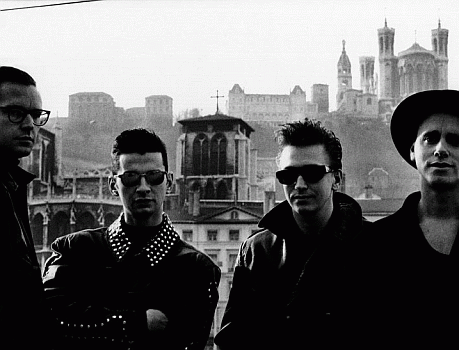
(with friendly permission of Alan Wilder)
On 13 April the single Strangelove / Agent Orange /Pimpf was released.
Alan: "Strangelove was the exact opposite to a song like
Stripped. Difficult to piece together, consisting as it did of many
little parts, it was hard to find one thing to pin the track down."[4]
The single was released before the final mixing of Music for the Masses.
The album version of Strangelove became different then, basing on the
original track and the 12" version (Blind Mix) by Daniel Miller. The single only
reached No. 16 in the UK charts, but hit No. 2 in West Germany and was a Top 10
success in several other Western European countries.
Beside the 7" mix, there were some different versions of Strangelove available,
the Maxi Mix, the Midi Mix, the Blind Mix, the Pain Mix
and the Fresh Ground Mix (both remixed by Phil Harding). For the U.S.
releases some other remixes were done. There were also some remixes of Nothing
available. There weren't any other versions of Agent Orange available
(an instrumental track that sounds very much as if Alan had composed it, but
it was written by Martin) while there was a different version of Pimpf
(another instrumental track) called Fpmip.
The promo for Strangelove was filmed in Paris and directed by Anton Corbijn.
He made a video for Pimpf as well. (While the video shows Martin playing the
piano, on the recording it was Alan.) An alternative video for Strangelove
was made at the American record company's request and directed by Martyn Atkins.
Alan: "It was probably something to do with the American record company
and / or MTV not being happy with Anton's original version."[6]
At the same time, they made fools of themselves at the attempt to get rid of their
image as bores by "throwing a party" for the magazine Smash Hits. It turned
out to be a disaster. Fletch, Martin and Dave got pissed, Fletch crawled around
under the tables, Martin got undressed and Dave was talking and talking and ...
"The French fans are unbelievable. They sit outside the
recording studio and if any of us come out they all barge up going 'Was that
eet? Was that the seengle ve just heard? Was eet the seengle?' And there was
one bloke, a complete weirdo who used to sit outside our hotel for literally
days and nights and he never said anything, just took photos of us all the
time. And he had on this combat jacket all the time and we thought he was going
to blow us up or something, you know, and we'd be going, 'Well, I'm not going
out the door first!' 'Neither am I!' 'Well I'm not!' and all that - he was
well weird."
When Alan, who didn't enjoy the "party" at all, went to the toilet, Dave
said, "He is enjoying himself!"
Martin: "He is! He's going crazy!"
Dave: "I can tell - he's gone to the loo! He got up! No, you can tell,
you see, because it's his eyebrows. When he's really excited his left eyebrow
goes up. Have you noticed that? And when he's depressed his right one goes down.
Is he just quiet? No, no, he's the old man of the band isn't he? I mean he's
27, 28 - he's probably gone for a kip actually! Does he know that we speak
about him like that? Um ... no!" (laughs)
Why do I go into this article at all? Well, it showed one thing quite clearly:
The quarrels that had started after Some Great Reward hadn't been settled.
The conflicts within the band actually seemed to be continuing, as Alan's
statement in this article showed: "I think this is a complete farce. I suppose you
think that we all get on really well together and it's like this all the time -
well, it isn't! We argue constantly and that's the real us, not ... this. Yeah,
I know I'm cynical but I'm also realistic."[7]
It seems that it got a bit harsher from this time onwards but I don't think it
was unbearable. There were a lot of articles at this time - mainly teenage
magazines - that implied conflicts that weren't there. DM were ascending to a
peak in their career, and were definitely enjoying it. It seems that it was a
time full of energy, but nevertheless the "development" of problems continued.

Because of their dissatisfaction with Strangelove, the band went back into
the studio and worked hard on the song and the album.
Dave recorded most of his vocals at Konk Studios in London to be close to
his wife, who was expecting their long-desired baby.
"My wife Jo is going to have a baby in October. I'm pretty excited
about it because we've wanted one for a long time. The thing is we had a good
go at it for quite a while and nothing happened. Then the minute we stopped
trying so hard she became pregnant. Typical. I really hope it arrives before
we go on tour. I can't imagine anything worse than being on stage and having
someone whisper in my ear that Jo's just had a baby. I mean what can you do?
You can't say to 10,000 people 'Excuse me my wife's just had a baby. I've got
to go!' I wanna be there - definitely. Alan's girlfriend, Jeri, is really
psychic, and about a week before we knew Jo was pregnant she came up to me
and said 'Is Jo going to have a baby?' It turns out she had a dream about it."[8]
In the meantime Jo had not only stopped to come on tour, but she also gave up
management of the fan-club.
Dave: "It all just got a bit too big. I'd come home, and there would
be posters and records everywhere - all I wanted was a break! I just couldn't
handle it. I just couldn't get away from Depeche Mode. It got to the stage
where we didn't talk anymore. She'd just ask me questions like 'What colour
socks were you wearing that night in Berlin?'"[9]
This year, Dave was also forced to leave Basildon and to move house to the south of the Thames. "I used to get a lot of fans outside my house. That's why I had to move with my wife, Joanne, and Jack, my son. They are fans from all over, from Germany, France, America, everywhere. They write to each other, word gets around and when I open up my door in the morning there are all these people on my doorstep. Sometimes I open the curtains, pull the blinds and there's somebody standing there snapping away with a camera! They're not all teenage girls, though. There was this bloke[10] - his name's Sean - actually hired a private detective to follow me from the studio and discover where I lived.[11] I remember seeing this car parked across the road a few weekends later, and it turned out to be full of fans. They were all looking through my window, and they'd always be there.[12] It got to the point where I'd be chasing them down the road with my dog because they'd be singing our songs outside my house at two in the morning.[13] And, one day, they finally plucked up enough courage to come and see me. So they knocked on the door.[14] I lost my rag and really shouted at him. I told him, basically to f*** off. Later I sent the guy a letter saying, 'I apologize, but you must respect my privacy. I want to have some time with my wife and son.' He sent back a letter saying, 'I'm sorry I bothered you, and I won't ever do it again.' Then, right at the end of the letter, he said, 'By the way, would it be possible for me to come 'round next weekend?' I just thought, 'Well, that's it. It's time to move.'"[15]
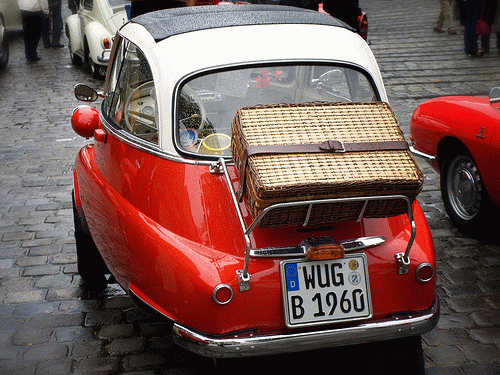
(Never Let Me Down Again - with friendly permission of © J. Miguel Caldera)
The band moved on to the lonely Puk Studios in Denmark to mix the album. DM
weren't satisfied with Music for the Masses thoroughly because the demos
didn't leave enough room for experiments. That was the reason for asking Martin
to present rougher demos for the next album.
On 20 August the single Never Let Me Down Again / Pleasure, Little
Treasure was released and would become an all-time-classic. It was a relatively
moderate hit in the UK, peaking at No. 22, but it was a smash hit in Western Europe.
Beside the 7" mix, there were three different versions of Never Let Me Down Again
available, the Split Mix, the Aggro Mix and the Tsangarides Mix
(remixed by Chris Tsangarides). There were two different versions of Pleasure,
Little Treasure available, the Glitter Mix and the Join Mix
(remixed by John Fryer & Paul Kendall). Some releases also included To Have
and To Hold (Spanish Taster).
The band, of course, was very proud of Never Let Me Down Again, especially
of the development they had taken. From that point forward - starting with
Black Celebration, they tried to push themselves into new dimensions
without using steady formulas musically.
Dave: "Things like Everything Counts and People Are People
will last forever. I even bet that in ten years' time there will be bands doing
covers of those songs. Our songs always convey an atmosphere: sad or optimistic,
it's full of substance. The new single Never Let Me Down Again really
gives me goose pimples. Not all our songs have this effect on me, but this
particular one is wild. People call DM an electronic band but it's wrong.
We use anything, from the acoustic guitar to the percussion via the most
sophisticated robots. The only thing we refuse are limitations and I don't
think there is a single band in the world that operates like us."[16]
It's amusing that he was right with the cover songs. Today there are so many
cover songs and fan remixes, you can hardly count them.
Martin: "There was one instance regarding Never Let Me Down Again
when two separate people came up to me after a show one night and said, 'I
really like that song'. One of them thought it was a gay anthem and the other
one thought it was a drug anthem."[17]
He himself would tend to the drug anthem, a flight from reality with drugs. This is
also the angle to follow when trying to interpret the lyrics of the album. They almost
all deal with being "high" from something - drugs, love, religion.
Alan: "It [Never Let Me Down Again] stood out as an obvious single and suggested a
Stripped-like feel. It has a very definite anthemic quality which
is especially demonstrated when the song is performed live and the whole
audience wave their hands in unison at the end - a Depeche high-point I think."
In addition, he mentioned the line Promises me I'm as safe as houses, as
long as I remember who's wearing the trousers as the one that made the
deepest impression on him. And last but not least he said about the video,
"This is one of my favourite Anton films. It has a very definite feel and a
mood that compliments the song perfectly."[18]
By the way - did you know that Never Let Me Down Again is the most played
song live? Although there are some setlists missing it's clear that Never Let Me
Down Again is on the top with about 720 times played live, followed by
Enjoy the Silence, Personal Jesus, A Question of Time, Stripped and
Everything Counts (all about 620 times). [The Delta Machine-Tour
isn't counted in. The statistic was done after Touring the Universe.]
The band members prepared for the release of the album.
Martin: "The album is going to be called Music for the Masses
which is a bit of a joke really, when you consider how much a lot of people
hate us."
Dave: "You wouldn't think it was possible to hate a band so much as
the way some people hate us!"
Martin: "I think our music never crosses over to the general public,
hence the album title, it's a joke. It's only the fans who buy our stuff."[19]
Likewise it was difficult for DM to get air-play on the radio.
Martin: "We're in a bit of a dilemma because most of our music doesn't
fit in and doesn't get played as much as others, though fortunately it does
elsewhere in the world. And if we find it difficult, and we think we're quite
commercial, it must be impossible if you're in a really alternative band."[20]
Neither Ultra nor Exciter was actually played by the big British
radio stations later, but it had already been difficult in the 1980s.
Fletch: "Probably we're still a cult band because we find it difficult
to cross over to anyone except our fans."
Martin: "I think it's nice to be more of a cult band that a hugely
successful group. I think you can get more out of it and it's a nicer feeling
in some way.[21] I think it's down to the intimacy of the music. People feel
that the songs are personal to them. And though there is an element of
contradiction when you play a concert with 17,000 people going mad, that
intimacy is still there. People still feel moved by it, they feel that it's
theirs. They feel that Depeche Mode is their cult thing, that the music
shouldn't ever go mainstream no matter what it sounds like and no matter
what we do."[22]
For the band, explaining why they were "cult" was as difficult as it was for
the fans in the survey of depechemodebiographie.de. Besides the personal
identification it must have been this "special magic" that let DM become a "power".
"They can't be compared, they're in their own league", "they were absolutely cool,
unique and different, and when you were a fan of theirs you were unique, different
and strange as well. I felt like a freak. It was something like a revolution."
The fact that they were "extremely popular without being famous" is one of the
"DM-phenomena" that Fletch summed up with, "we find it difficult to cross over
to anyone except our fans" and one fan with, "they are the best kept secret in
music ever."
"DM is the strange antagonism of underground and mainstream, being different and
identification, melancholy and hope", as one fan described this "mystery".
The same can be said about the fans. They are a strange antagonism of being
individuals and a big community that connects "devotees" all over the world.
While there's a lot of communication between the fans all over the world,
Martin explained about his lyrics that,
"it's true that many Depeche songs deal with communication
problems. There are a lot of recurring themes in my songs. One thing that
always reappears is disillusionment and lack of contentment. A lot of the
songs also deal with a search for innocence. I've got this theory that as you
get older you get more disillusioned and that your happiness peak is when
you're in your teens. As you grow older and learn more, the corners are
rubbed off your life. I think we exploit the rut instead by writing songs
about it. We're making money out of the rut that we and others are stuck
in." (laughs) "In fact, we're craving for something more depressing to come
along to take us out of our boredom." (laughs) "As you can see we're such an
up band at interviews." (giggles) "I think that the only reason we sell more
records abroad than we do in England is because foreigners don't understand
us. They just hear us laughing every now and then and dig it." (laughs)
About the line What am I trying to say? / I'm not trying to tell you
anything you didn't know when you woke up today in the song Nothing
Martin said, "I think that the line is true about all our songs.
If you're writing a good song you're not telling anybody any new information.
All you're doing is putting down hopefully shared feelings that somebody else
can agree with."[23]
About To Have and To Hold Alan explained,
"Martin submitted his demo in the usual way and although I liked the song,
his original idea was too 'lightweight' for my taste (and I felt, the mood
of the album) so I pushed it in a darker, more atmospheric direction. This was
the primary version of the song which was always intended to be on the album.
Martin however was very attached to his more 'poppy' demo and said that he
wanted to record it too - hence the 'Spanish Taster'. It wasn't a question of
fighting with one another over this, it's just that Martin saw the song in a
different way to me. I don't think there is a more perfect example of the
musical differences between myself and Martin."[24]
It's interesting to listen to these two different versions, because they
really show the different views of the two musical heads of the band. While the
final album version is atmospheric, dark and filled with sounds, the
Spanish Taster is more minimalistic, melodic and direct.
By the way, the speech at the beginning of To Have and To Hold is Russian
and can be translated with: "Evolution of nuclear arsenals and socially-psychological
aspects of arms race is considered in these reports."
I was asked by a reader if it was used to make a political statement. But Alan
said once that they didn't even know what it meant. It sounded interesting to them,
so it was used.
Due to the circumstance of never getting any answer according to the question
if I might stream excerpts of Depeche-Mode-songs on this website, I decided to
ask some artists who did cover-versions.
So here is an excerpt of To Have and To Hold by Bay Laurel:
(with friendly permission of © Bay Laurel)
On 28 September Music for the Masses was released. The
album became the band's highest-charting in the U.S. upon its release, reaching No.
35 on the Billboard 200. It also contained more hit singles than any of their
previous releases.
While Alan was still programming the keyboards for the tour, Dave became a
father. On 14 October his son Jack was born, a few days before the tour started.
The Masses-Tour consisted of five legs and began on 22 October with
the first European leg. It comprised 19 gigs and ended on 18 November.
The first American started on 1 December, comprised 11 concerts, and
ended on 18 December.
On 28 December the single Behind the Wheel / Route 66 was
released. Beside the 7" mix, there were two different versions of Behind
the Wheel available, the Shep Pettibone Mix and the Beatmasters
Mix; on some U.S. releases there were some more remixes available. The
same with the single's B-side Route 66. On the UK-releases there were
the Beatmasters Mix and the Casualty Mix available, and there
were some more remixes on other releases.
Route 66 wasn't planned at all, particularly not as an A-side. As such
the single was released in the U.S.
Fletch: "That was an accident, that was not meant to be, really.
It was only supposed to be a bit of a laugh, and the Americans liked it
and were putting pressure on, and things like that. It's a bit of a shame
really, because we think Behind the Wheel, which was supposed to be the
'A', is a better song, but ... No, actually, Route 66 is a really good song,
it's just that we don't really like doing cover versions as a rule, especially
when we've got our own songs available, it just seems a bit of a waste.
This'll be the last single. We've never believed in sort of doing a Madonna
or whatever and releasing eight singles off an album. We just think it's a
waste: the album's the album and you take singles off to promote the album
but, I mean, once enough people have bought the album, that's alright."[25]
(Nevertheless, there was another single release with Little 15 later.)
The lyrics and the lead melody of Route 66 were originally written by
Bobby Troup's band, but the music itself is similar, sometimes identical,
to Behind the Wheel. Martin was taking care of the lead vocals on
Route 66, maybe the most aggressive he has ever sung. On stage the song
was sung by Dave.
The video for Behind the Wheel was directed by Anton Corbjin again.
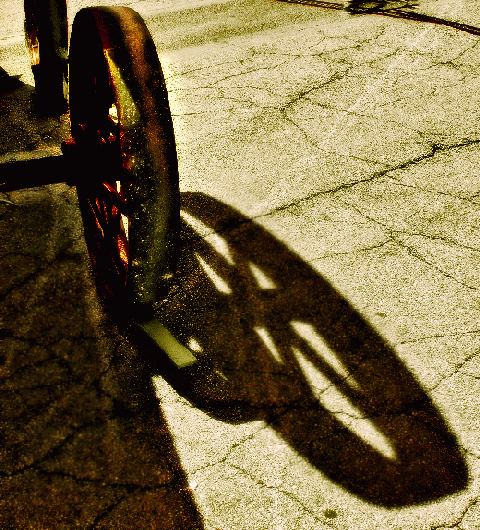
(Behind The Wheel - with friendly permission of © Marina Muolo)
And here are two little interesting bits at the end of this chapter:
In 1989 Martin said, "About two years ago we did sign a very small
agreement with Daniel because it was pointed out to us, what would happen
if Daniel died? He was very overweight at the time, and if he died we
wouldn't be paid a penny. So there's a sheet of paper which says we're to be
paid on a 50-50 basis. In England we pay 50 per cent of all our costs and
get 50 per cent of all our profits. In Europe we get 75 per cent of our
profits through licensing deals."[26]
Until this time there actually wasn't any official contract with Mute, only
with the licensees.
For later years this statement was interesting:
Alan: "The main danger is a drying up of things to write about. There's
a lot of repetition in this business, and Martin's songs ... he does repeat
himself quite a lot. I think Dave has aspirations to write, but feels a bit
unconfident about putting anything forward because if he did it would be in
a very basic form as he can't really play any instruments. I think he has
ideas about words and lyrics. I have written stuff, but I've not been happy
with any of it."[27]
This would mean Fletch, who claimed later Dave would have never had ambitions
to write songs on his own, wouldn't have been informed correctly or was quoted
incorrectly.
When I had the opportunity to enquire, Alan confirmed,
"Dave did have ambitions and he did talk
about songs he wished to propose, but he didn't seem to
have the confidence to actually present them."[28]
Many years later Dave said, "I started playing around with words in the
mid-'80s, but I couldn't take it to Martin, out of fear that it would be
rejected, laughed at."[29]
References:
[1] www.recoil.co.uk
[2] depechemodebiographie.de
[3] The Jagger Reports - Interview with Alan Wilder, Backstage, April 1988. Words: Chris Jagger.
[4] Mode-Al, Making Music, June 1987. Words: Jon Lewin
[5] www.recoil.co.uk
[6] www.recoil.co.uk
[7] Fzss!...Zwiing! Aargh!..Hahahah!! Smash Hits, 6-19 May 1987. Words: Sylvia Patterson
[8] Intimate Details, No. 1, 12 September 1987. Words: Uncredited
[9] Intimate Details, No. 1, 12 September 1987. Words: Uncredited
[10] Real Gahan Kid, Sky, March 1990. Words: Paul Lester
[11] Violator, Alligator, NME, 7 July 1990. Words: Jeff Giles
[12] Real Gahan Kid, Sky, March 1990. Words: Paul Lester
[13] Violator, Alligator, NME, 7 July 1990. Words: Jeff Giles
[14] Real Gahan Kid, Sky, March 1990. Words: Paul Lester
[15] Violator, Alligator, NME, 7 July 1990. Words: Jeff Giles
[16] 80's, Mode d'Emploi, Best, October 1987. Words: Gerard Bar-David
[17] Rolling Stone, 1993, Words: Marvin Scott Jarrett
[18] www.recoil.co.uk
[19] Mass Appeal, Underground, August 1987. Words: Carole Linfield
[20] Mass Appeal, Underground, August 1987. Words: Carole Linfield
[21] Dep Jam, Record Mirror, 22 August 1987. Words: Francesco Adinolfi
[22] Faith, Hope and Depravity, Select, December 1990. Words: Andrew Harrison
[23] The Dire Straits of the Synth Generation? Sounds, 5 September 1987. Words: Jack Barron
[24] www.recoil.co.uk
[25] Depeche Mode: The Interview, Talking Music SPEEK013, 1988
[26] The Unlikely Lads, Q, April 1989. Words: Mat Snow
[27] Mode-Al, Making Music, June 1987. Words: Jon Lewin
[28] Depechemodebiographie.de
[29] Interview with Dave Gahan, Mojo, 22 March 2013. Words: Martin Aston.